Restarting from a Goal Kick – Drill
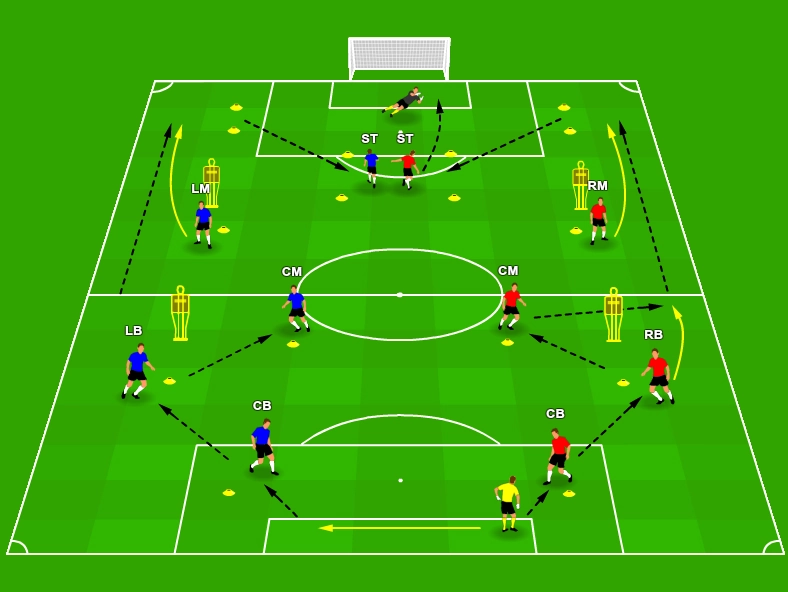

Nothing deflates a team faster than botching a goal kick and gifting the opponent a tap-in. This pattern walk-through keeps your goalkeeper, centre-backs, and wingers aligned on how to break the first line of pressure and attack down the flank.
Setup
- Players: 12 (2 goalkeepers, 4 defenders, 4 midfield/wingers, 2 strikers). Rotate extra players every 10 minutes.
- Area: Full-size pitch with cones marking wide channels, mannequin defenders, and a small target box just outside the penalty area.
- Equipment: Balls, cones, mannequins or poles, stop-watch to score timed races between the left and right units.
Split the squad into “left” and “right” teams. Each team mirrors the same pattern on its own side so both fullbacks get reps.
Pattern of play
- Goalkeeper plays short to the nearest centre-back (CB). Immediately serve the opposite CB to start the other team’s repetition.
- CB opens up and feeds the overlapping fullback (RB/LB) stationed near the corner of the box.
- Fullback plays inside to the central midfielder (CM) positioned just beyond the edge of the box, then sprints down the line around a mannequin.
- CM returns the ball into the path of the overlapping fullback before the halfway line.
- Fullback hits a bending pass down the wing for the wide midfielder (RM/LM) sprinting toward the corner flag—ball must be released before crossing halfway.
- Winger drives to the end line and crosses through a cone gate toward a striker starting outside the penalty area.
- Striker finishes first-time from outside the box. Only touches inside the 18 come from defenders attempting to block.
Score every clean finish and keep tallies for the left-versus-right competition over 10–15 minute blocks.
Coaching cues
- Centre-backs must receive side-on inside the box—new goal-kick laws allow it, so use the space.
- CM’s return pass should be weighted so the fullback can cross the halfway line in stride.
- Demand quality on the diagonal into the winger; it should arrive just ahead of the runner.
- Striker’s run starts on the edge of the box to mimic arriving late rather than camping with defenders.
Progressions
- Add passive pressers to hassle the fullback or CM once the pattern is smooth.
- Allow the winger to cut inside and combine with the striker instead of crossing every time.
- Introduce point deductions for sloppy passes or touches inside the penalty area to keep standards high.
Takeaways
- Mechanised movements. Everyone learns their lane so the team can restart without confusion on matchday.
- Positional discipline. Players get repetition staying in shape while the ball moves from back to wing.
- Triangulation. The CB–FB–CM triangle repeats on both sides, sharpening one-touch play under pressure.
- Delivery and finishing. Wingers rehearse whipped crosses while strikers master hitting through traffic from the top of the box.
- Goalkeeper decision-making. Keepers practise splitting centre-backs quickly instead of thumping hopeful long balls.
Add your tweaks—maybe inverted fullbacks or a third-man runner—and tell us about it on Facebook or Instagram @footballtechnik.
Related Posts
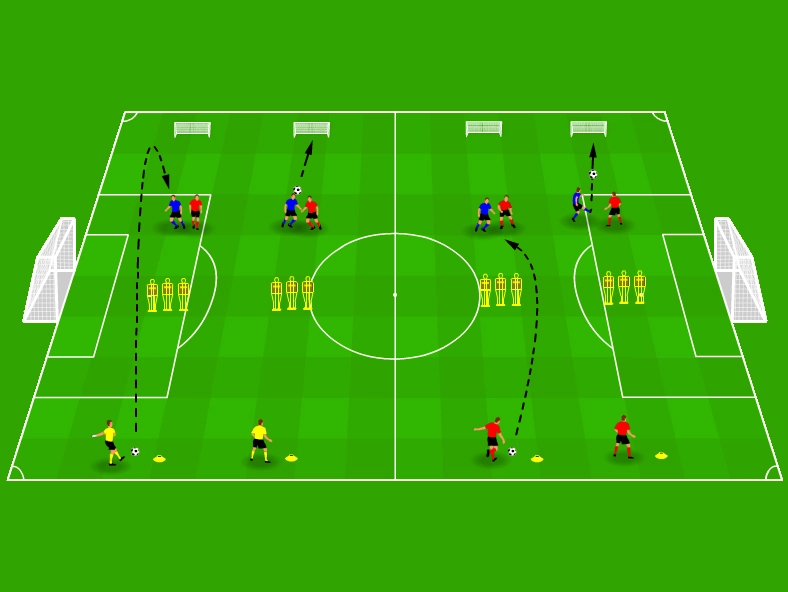
Restarting from a Long Goal Kick – Drill
Coach your goalkeeper, target player, and defender through a competitive long goal-kick routine with a points ladder for flicks, chest control, and shots.
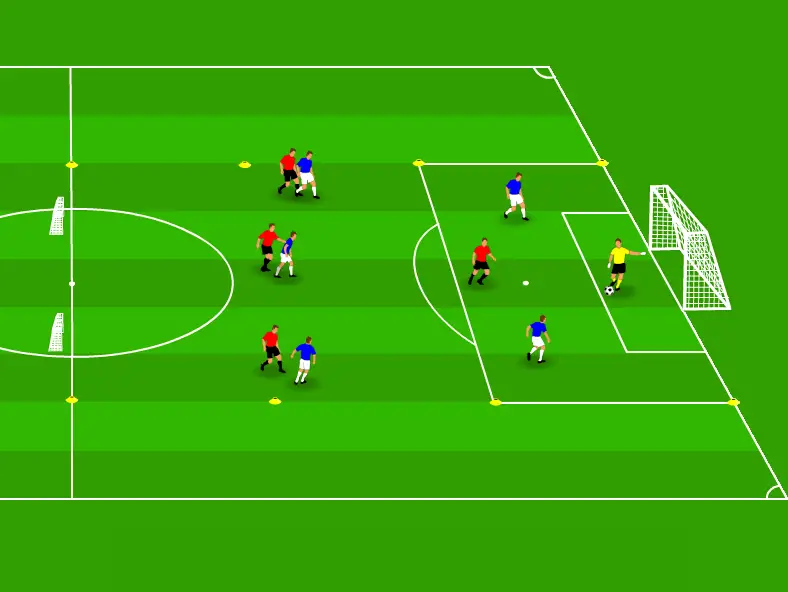
Build up from your defensive half
Sunday league teams often restart the game with a long kick from the goalkeeper. It may feel like an easy way to keep the opposition away from your goal...

Goalkeeper distribution drill - Strikers vs goalie
This post describes a goalkeeper distribution drill that will help your keeper transition from defence into attack quickly and accurately.