Football Strength and Conditioning: 10 Key Areas

In adult football, the game rarely slows down for you — it speeds up. Players are asked to press, recover, duel, and make clean decisions while fatigue builds, and that’s where matches are often won or lost. Football strength and conditioning gives you the physical base to keep your technique and tactical choices reliable when the tempo rises, especially late in the game.
Football strength and conditioning is not just about lifting heavy weights in the gym. It is about building strength that shows up on the pitch — in accelerations, duels, changes of direction, and repeated high-intensity efforts — so you can stay balanced under pressure and remain effective from the first minute to the last.
Effective strength and conditioning for football combines on-pitch work, athletic development, and intelligent recovery. Acceleration, deceleration, jumping, duels, and repeated sprints all place specific demands on the body that must be trained deliberately and in context.
Below are ten key areas that form the foundation of football strength and conditioning. While some may appear indirect at first glance, each contributes to helping players perform consistently, reduce injury risk, and cope with the real demands of the game.
1. On-Pitch Training
On-pitch football training is the cornerstone of any effective conditioning programme. Small-sided games, positional exercises, transition drills, and matches expose players to the exact physical and tactical demands they face in competition.
Every acceleration, deceleration, change of direction, jump, tackle, and duel places load on the body in ways that cannot be fully replicated in the gym. A single session can involve hundreds of directional changes and repeated high-intensity actions.
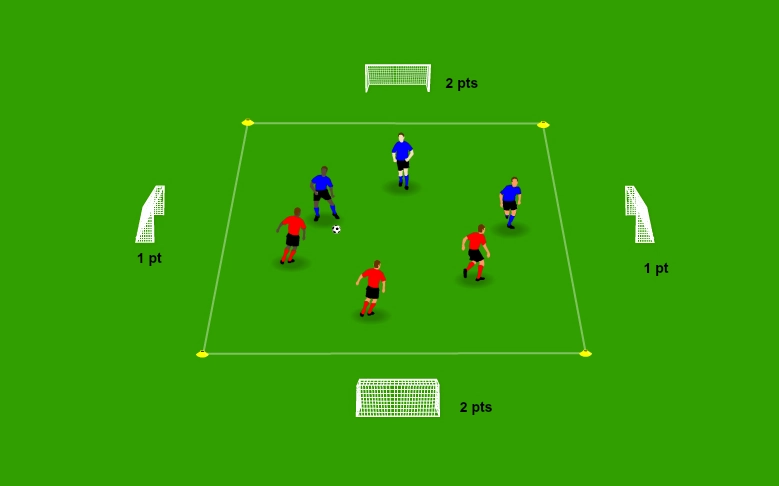
If you want conditioning that truly transfers to match performance, build it into competitive formats. For example, a High-Intensity 3v3 game naturally trains repeated sprints, duels, and decision-making under fatigue, while this 5-a-side game with reduced spaces forces constant scanning, sharp movement, and fast recovery runs in tight areas.
2. Elastic Strength & Resilience
Football performance relies heavily on the body’s ability to absorb force and reapply it efficiently. Elastic strength refers to how well muscles, tendons, and connective tissues work together to store and release energy.
This quality is developed through hopping, skipping, bounding, sprinting, and controlled landing mechanics. Strong and resilient tissues allow players to change direction more efficiently, jump repeatedly, and tolerate the cumulative load of training and matches.
Instead of isolating muscles, football conditioning should focus on improving force transfer through the ankles, knees, hips, and trunk — the “engine room” of explosive movement.
3. Breathing & Core Control
Breathing mechanics support posture, trunk stability, and recovery between high-intensity efforts. Poor breathing habits can reduce efficiency and accelerate fatigue late in games.
Simple breathing work can help players:
- Maintain better posture during movement
- Recover faster between sprints and pressing actions
- Stay composed under pressure when legs are heavy
This does not require long routines. Even a few minutes of focused breathing during warm-ups, breaks, or recovery sessions can support overall performance.
4. Balance & Coordination
Balance and coordination underpin almost every football action. Shielding the ball, tackling, landing from aerial duels, and receiving under pressure all demand precise control, often on one leg.
Balance and coordination training improves the nervous system’s ability to manage force in unstable and unpredictable situations. This leads to better movement efficiency, fewer injuries, and improved technical consistency when fatigue sets in.
Practical approaches include single-leg strength work, reactive balance challenges, and movement patterns that force players to stabilise quickly before accelerating again.
5. Footwork
Footwork bridges balance and coordination with speed and agility. Efficient foot placement determines how quickly a player can accelerate, decelerate, and change direction.
Tools such as agility ladders can be useful, but footwork training should prioritise:
- Sharp changes of direction
- Deceleration mechanics (braking under control)
- Movement efficiency rather than just moving fast
Where possible, add a ball so the footwork transfers into realistic match movement — this speed dribbling drill is a good example of blending fast feet with close control.
6. Plyometrics
Plyometric training develops the ability to produce force quickly — a key requirement in football. Sprinting, jumping, and explosive directional changes all rely on effective stretch-shortening cycles.
Exercises such as jumps, bounds, and hops teach players to absorb force safely and reapply it explosively. When progressed correctly, plyometrics improve power output while reducing injury risk.
Single-leg and lateral variations are especially relevant to football movement patterns, because most match actions happen off one foot and often include contact or imbalance.
7. Speed & Agility
Speed and agility turn athletic qualities into match-winning actions. Speed refers to acceleration and top-end velocity, while agility involves decelerating, changing direction, and re-accelerating efficiently.
In football, agility often matters more than straight-line speed. Players must react to opponents, adjust movement in tight spaces, and change direction at high intensity under pressure.
Effective speed and agility work focuses on:
- First-step acceleration (winning the first 2–3 metres)
- Controlled deceleration (braking without collapsing)
- Directional changes that mirror match demands
To make this competitive and game-realistic, use a duel-based format like the West Ham 1v1 drill, where players must accelerate, stop, and re-accelerate under pressure.
8. Strength & Conditioning
Strength training supports all other physical qualities. In football, the objective is usable strength that transfers directly to the pitch.
Bodyweight exercises, isometric holds, and controlled resistance training help players cope with contact, maintain balance in duels, and protect against injury. Think of strength as the base that allows everything else — speed, agility, and technique under pressure — to remain consistent.

Conditioning should prioritise repeated sprint ability and match-intensity efforts, using interval-based running and football-specific games instead of long, steady endurance runs. If you want practical conditioning that stays football-specific, start with these fitness drills with a ball and add a sharp technical component like this high-intensity passing circuit.
9. Cross-Training
Cross-training can be useful, particularly during the off-season. Sports such as swimming, basketball, or martial arts expose players to different movement patterns and physical demands.
This variety supports overall athletic development while reducing repetitive load from football-specific actions. Used correctly, cross-training can enhance aerobic capacity and aid recovery without compromising football performance.
The key is timing: cross-train to stay athletic and fresh, not to replace the football work that builds game-specific sharpness.
10. Recovery
Recovery is where adaptation occurs. Without adequate recovery, even the best football strength and conditioning programme will eventually lead to fatigue, reduced performance, or injury.
Key recovery priorities include:
- Quality sleep
- Proper nutrition and hydration
- Managing weekly training and match load
Elite players treat recovery as seriously as training itself, ensuring they can maintain performance throughout the season rather than peaking for one good month and fading. A simple way to support this is to make warm-ups consistent and protective — these football warm-up drills are a solid starting point for injury prevention and readiness.
Conclusion
Effective football strength and conditioning requires a holistic approach. Gym work alone is not enough, and neither is endless running. Players must train physical qualities in a way that reflects the true demands of the game.
By developing these ten areas consistently, footballers improve physical resilience, sustain performance under fatigue, and reduce injury risk — allowing technical and tactical qualities to shine when it matters most.
To put these principles into action, build sessions around realistic intensity: small-sided games, competitive drills, and repeated high-quality efforts — then protect recovery so players can repeat it week after week.
Frequently Asked Questions
What is football strength and conditioning?
Football strength and conditioning is the structured training of physical qualities (strength, speed, power, endurance, coordination, and resilience) to meet the repeated high-intensity demands of matches.
How often should adult amateur footballers do strength and conditioning?
Most adult amateurs benefit from 2–3 sessions per week, adjusted around match day and football training intensity. If you play once per week, one strength session and one conditioning session is often a strong baseline.
Is gym training necessary for football?
Gym training can help, but it should complement on-pitch work. The priority is transferable strength (hips, trunk, single-leg stability) that improves sprinting, duels, and change of direction.
How can I improve football conditioning without just running?
Use conditioning formats that mirror football: small-sided games, high-intensity circuits with the ball, and repeated-sprint drills. These build fitness while also sharpening decision-making and technique.
Should I do plyometrics every week?
Yes, but keep the dose sensible. 1–2 short plyometric blocks per week (often inside warm-ups) can improve power and stiffness without overloading players, especially when match volume is high.
Get Involved
If you’ve got a favourite conditioning game or a weekly training structure that keeps your team sharp late in matches, share it with us on Facebook or tag @footballtechnik. The best ideas usually come from what works on real amateur pitches.
Related Posts

Football Warm-Up Drills: Simple Exercises to Avoid Injuries
Run these Level 1 running sequences and finish with higher-intensity cuts so your squad hits training at full speed.
Fitness Drills for Football With a Ball – 5 Essential Ideas
Training for fitness without a ball can be very dull. These football fitness drills with a ball will make your training more enjoyable.
High-Intensity 3v3 Game: Boost Fitness and Teamwork
This high-intensity 3v3 game improves ball control, decision-making, and fitness. It is perfect for small teams or training sessions with limited attendance.